⏰ 7 min read | August 17, 2026
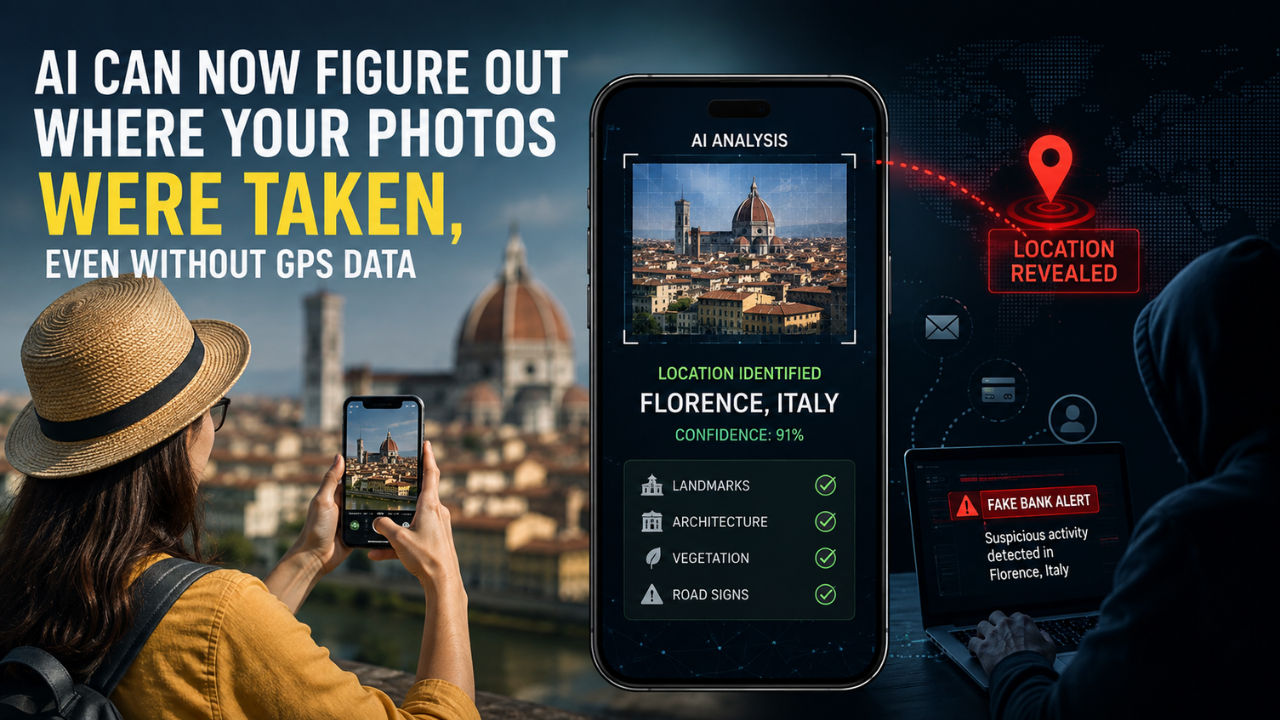
AI photo location detection has quietly become good enough to guess exactly where your holiday pictures were taken, even if you never turned on GPS and even if you scrubbed every bit of hidden metadata before posting. A new study from McAfee Labs found that modern AI models can correctly spot the country or city shown in a photo an astonishing 87 to 91 per cent of the time, just by looking at what is visible in the frame. No coordinates. No location tags. Just buildings, signboards, and background scenery doing all the talking.
What Is AI Photo Geolocation?
Think about the last time you posted a beach photo or a picture from a hotel balcony. You probably assumed that as long as you turned off location tagging, nobody could tell where you actually were. That assumption is no longer safe. AI photo geolocation is a technique where an image-recognition model looks at everything inside a picture, not the invisible data attached to it, and works backward to figure out a real-world location.
This isn’t science fiction. Researchers at McAfee Labs ran a series of tests using ordinary travel photos and found that today’s AI tools are remarkably good at this kind of visual detective work. It doesn’t need a caption, a hashtag, or a GPS pin. It just needs enough of the scene to be visible.
Did You Know? The AI doesn’t need a famous landmark like the Eiffel Tower to succeed. It can often narrow down a location just from a hotel room’s window view, the style of a street sign, or the specific type of road markings used in a particular country.
How AI Figures Out Where a Photo Was Taken
The trick lies in pattern matching at a massive scale. AI models used for this kind of geolocation are trained on millions of images tagged with real locations. Over time, the model learns to associate certain visual patterns with certain places. Once it’s trained, you can hand it a brand-new photo with zero location data, and it will scan the image for familiar signals.
According to the report, the AI pays close attention to details most of us would never think twice about, including:
- Architecture and building styles typical of a region
- Road signs, number plates, and traffic markings
- Vegetation, terrain, and general landscape features
- Recognisable landmarks, however minor
- Small design cues like door shapes, electrical fittings, or shop signage
Put these small clues together and the AI can make a confident guess about the country, the city, and sometimes even the neighbourhood, all without a single GPS coordinate anywhere near the file.
How Accurate Is This Technology?
This isn’t a party trick that works occasionally. The numbers from the McAfee Labs research are striking: AI systems correctly identified the location in 87 to 91 per cent of tested travel photos. That level of accuracy holds up even for photos that seem generic on the surface, a plain hotel room, a riverside view, or a busy street corner, scenes that most people would assume are impossible to trace.
What makes this especially notable is that the AI performs this well without relying on the GPS or EXIF data baked into a photo file. Even if you or your phone stripped that metadata out before sharing, the visual scene alone is often enough for the AI to work with.
Why This Matters for Your Privacy
At first glance, this might sound like a neat AI party trick, but the report points to a real and growing risk. Once bad actors know exactly where you are, or recently were, they can build far more convincing scams. Imagine getting a message that references your actual hotel by name, or a fake "local delivery" alert timed perfectly to when you are travelling abroad. These aren’t generic phishing attempts anymore; they are personalised, location-aware traps built using nothing more than a photo you posted publicly.
The report specifically flags this as a rising concern for criminals looking to craft believable, targeted phishing messages using publicly shared travel photos. Since so many of us post vacation pictures in near real time, this creates a window where scammers know precisely where to strike and how to make their approach feel legitimate.
How to Protect Yourself
The good news is that a few small habit changes go a long way here. None of these require technical expertise, just a bit of extra caution before you hit "post."
- Wait until you’re home: Post travel photos after your trip ends rather than while you’re still there, so nobody can pinpoint your live location.
- Limit your audience: Share travel content only with trusted friends and family instead of a fully public account.
- Scan before you share: Look closely at each photo for identifiable details, street signs, hotel names, house numbers, before uploading it anywhere.
- Don’t rely on metadata removal alone: Stripping GPS and EXIF data helps, but as this report shows, it isn’t a complete fix since the AI reads the scene itself.
| Specification | Details |
|---|---|
| Detection method | Visual scene analysis (buildings, signage, landscape, landmarks) |
| Requires GPS/EXIF data? | No, works even when metadata is removed |
| Accuracy rate reported | 87% to 91% of tested travel photos |
| Research source | McAfee Labs |
| Primary risk identified | Location-aware phishing and targeted scams |
| Category | Details |
|---|---|
| Original Price | Not applicable — this is a research finding, not a commercial product |
| Current Price | Free — similar AI geolocation capability already exists in publicly available AI tools |
| Bank Card Offer | Not applicable |
| EMI | Not applicable |
| Exchange | Not applicable |
Frequently Asked Questions
Yes. According to McAfee Labs research, AI systems correctly identified the location shown in 87 to 91 per cent of tested travel photos, even with GPS and EXIF metadata fully removed.
It studies visible clues like buildings, road signs, architecture, road markings, vegetation, landscapes, and landmarks, then matches those patterns against huge training datasets to guess the location.
Not fully. Stripping metadata removes hidden coordinates, but the AI reads the visible scene itself, so a stripped photo can still be traced.
Scammers can use location clues to craft personalised phishing messages, like fake hotel or delivery alerts, timed to when you’re travelling, making the scam far more convincing.
Post pictures after you return home, limit sharing to trusted contacts, and check each photo for identifiable landmarks or signage before uploading.
Verdict: Should You Be Worried?
The takeaway here isn’t that you should stop sharing travel photos altogether, it’s that the old trick of "just turn off GPS tagging" no longer offers the protection it once did. AI photo location detection has quietly gotten good enough to read a scene the way a sharp-eyed local would, and that changes how careful we need to be about what we post and when. A little patience, waiting until you’re back home, and a quick scan for identifiable details before you hit share can go a long way in keeping you a step ahead of scammers.
Want more breakdowns of how AI is reshaping everyday privacy and security? Head over to JatinTechTalks for more explainers like this one.
```


No comments:
Post a Comment